
Aavishkaar Consultants – Trusted Experts in Structural Engineering
Keeping your building safe, strong, and future-ready starts with the right professionals by your side.
At Aavishkaar Consultants, we deliver structured, transparent, and practical solutions to protect the long-term health of residential, commercial, and industrial buildings.
Our core services include:
✔ Structural Audits
✔ Project Management Consultancy (PMC)
✔ Building Repairs & Redevelopment Support
📞 Contact: 9819845747
🌐 Website: www.structuralauditor.in📝 Contact Form: https://forms.gle/doWSvEyfCwo3CPpH9
📸 Instagram: https://www.instagram.com/aavishkaarconsultants/📘 Facebook: https://www.facebook.com/profile.php?id=100083661032724💼 LinkedIn: https://www.linkedin.com/company/aavishkaarconsultant/?viewAsMember=true
What Is a Structural Audit and Why It Matters
A structural audit is a systematic health check of a building.
It assesses the strength, stability, and condition of structural components such as columns, beams, slabs, and foundations.
Over time, buildings face wear due to age, weather, poor maintenance, leakage, and load changes.
A structural audit identifies risks early.
It helps prevent sudden failures, costly repairs, and safety hazards.
Structural audits are mandatory for older buildings in many urban regions.
They also support decisions related to repair, strengthening, or redevelopment.
At its core, a structural audit answers three critical questions:
Is the structure safe?
What defects exist?
What action is required, and how urgent is it?
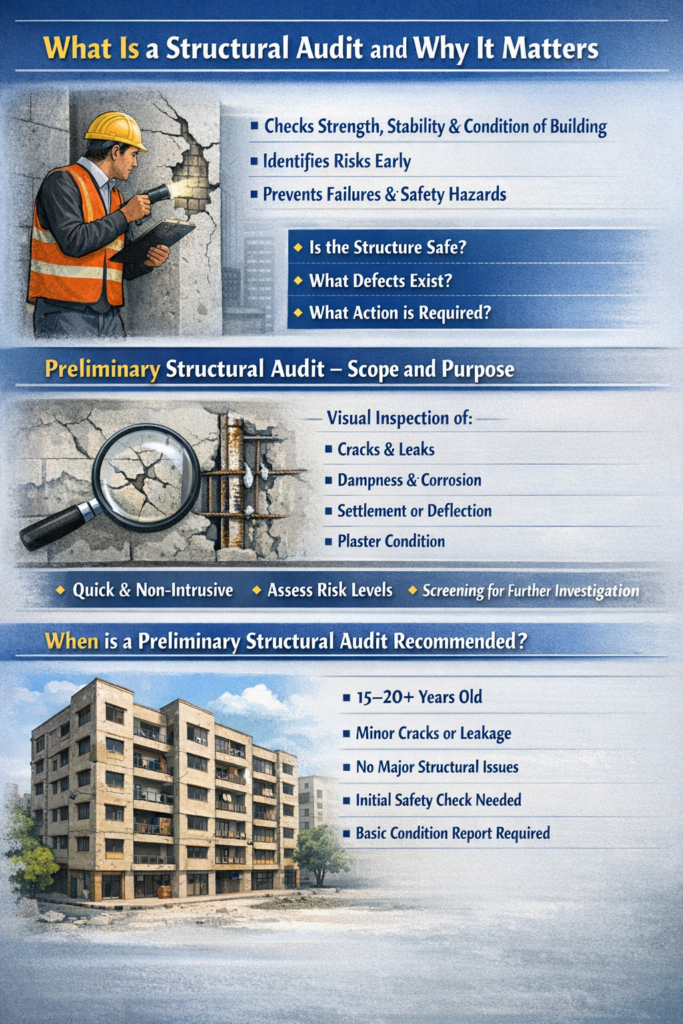
Preliminary Structural Audit – Scope and Purpose
A preliminary structural audit is the first-level assessment of a building.
It focuses on visual inspection and basic evaluation.
The auditor checks visible signs such as:
- Cracks in walls, beams, and slabs
- Dampness, leakage, and corrosion
- Settlement or deflection
- Condition of plaster and finishes
No advanced testing is conducted at this stage.
The goal is to identify obvious distress and assess whether deeper investigation is needed.
This audit is quicker, cost-effective, and non-intrusive.
It provides an overall condition grading of the structure.
A preliminary audit is not meant for repair design.
It acts as a screening tool to determine risk levels.
When a Preliminary Structural Audit Is Recommended
A preliminary structural audit is suitable when:
- The building is over 15–20 years old
- Minor cracks or leakage are visible
- There is no history of major structural distress
- An initial safety check is required
- Authorities or housing societies need a basic condition report
It helps housing societies plan future maintenance.
It also supports budgeting and prioritization of repairs.
Detailed Structural Audit – Scope and Purpose
A detailed structural audit is an in-depth technical investigation.
It is conducted when risks are identified during the preliminary audit or when serious distress is visible.
This audit includes:
- Structural analysis
- Material strength evaluation
- Load assessment
- Non-destructive and semi-destructive testing
The objective is accuracy.
It determines the exact cause, extent, and severity of damage.
A detailed audit forms the technical base for:
- Structural repairs
- Strengthening schemes
- Load enhancement
- Redevelopment decisions
It results in a comprehensive report with repair methodologies and specifications
Tools and Tests Used in a Detailed Structural Audit
Common tests include:
- Ultrasonic Pulse Velocity (UPV) Test
- Rebound Hammer Test
- Core Cutting and Compression Test
- Half-Cell Potential Test
- Carbonation Depth Test
These tests evaluate concrete quality, corrosion levels, and load capacity.
They allow informed, data-backed decisions.
Key Differences Between Preliminary and Detailed Structural Audit
|
Aspect |
Preliminary Audit |
Detailed Audit |
|
Inspection Type |
Visual |
Visual + Testing |
|
Time Required |
Short |
Longer |
|
Cost |
Lower |
Higher |
|
Testing |
Not included |
Included |
|
Output |
Condition overview |
Repair-ready report |
|
Purpose |
Screening |
Decision-making |
Both audits serve different roles.
One does not replace the other.
Which Structural Audit Does Your Building Need?
Choose a preliminary audit if:
- The building shows early signs of distress
- No major damage is visible
- You need an initial assessment
Choose a detailed audit if:
- Structural cracks are widening
- Corrosion or spalling is present
- Load changes are planned
- Repair or redevelopment is under consideration
A qualified structural auditor can guide the decision after site inspection
Role of Aavishkaar Consultants in Structural Audits
Aavishkaar Consultants follows a methodical audit process.
Every recommendation is backed by site data and engineering logic.
We focus on:
- Clear reporting
- Practical repair solutions
- Safety compliance
- Long-term durability
Our audits support societies, owners, and developers at every stage.
From assessment to execution support, we ensure accountability and clarity.
Frequently Asked Questions (FAQs)
Q1. Is a preliminary structural audit mandatory?
It depends on local authority guidelines and building age.
Q2. Can repairs be planned based only on a preliminary audit?
Minor repairs can be planned, but major work needs a detailed audit.
Q3. How often should a structural audit be done?
Typically every 5 years for older buildings.
Q4. Is non-destructive testing safe for occupied buildings?
Yes. Most NDT methods are safe and non-intrusive.
Q5. Who should conduct a structural audit?
Only a qualified structural engineer or authorized structural auditor.
A well-explained and timely blog by SMCA. The distinction between a Preliminary Structural Audit and a Detailed Structural Audit is clearly articulated, helping societies and stakeholders understand when and why each audit is required. Especially useful is the emphasis on preliminary audits as a screening tool and detailed audits as a decision-making foundation for repairs or redevelopment. This kind of clarity is essential for proactive building maintenance and long-term structural safety. Well done.